Quote (J-Breakz)
Direct democracy is a type of political government. There are still rulings being made in the councils.
What rulings ? if everything is based on free association ? and also individuals have a say in each decision proportionate to the degree to which they are affected by it.
Quote (J-Breakz)
A state is a set of institutions that possess the authority to make the rules that govern the people in one or more societies - wikipedia
One has the same authority over his private property and over his workers  . Large Firms or Corporations act exactly like STATES they have decision making power over a given territory as you suggest they have centralization , hierarchy , bureaucracy . Plus a minority is bound to RULE in anarcho-capitalism the class nature of capitalism creates that .
Quote (J-Breakz)
Yes I know plenty about mutualism. Your link doesn't work.
Oh sorry . Check this then http://praxeology.net/BT-SSA.htm
Quote (J-Breakz)
So the video is interviewing pretty much a sample of people. I'm not going to have my opinion swayed just because a documentary interviewed a small amount of people. If I wanted to and I had the cash, I can make a documentary interviewing russian people talking about we need another soviet union, that doesn't mean the majority of russians agree. Or even that it's justified. I think Mike Myers pretty much showed people that there can be a huge bias in documentaries.
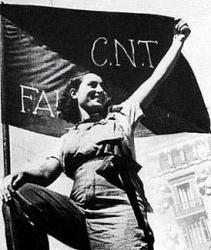
Most of them are the actual anarchists of the CNT-FAI that helped the collectivization process . I personally meet several anarchists from these 2 documentaries . Most of them are still active in the CNT-FAI and the IWA which i am part off
Quote (J-Breakz)
Do you have evidence that ALL or nearly all the factories increased their product output?
Dolgoff quotes the French anarchist historian Gaston Leval (who was an active participant) to summarize the anarchist conception of the social revolution:
In Spain during almost three years, despite a civil war that took a million lives, despite the opposition of the political parties (republicans, left and right Catalan separatists, socialists, Communists, Basque and Valencian regionalists, petty bourgeoisie, etc.), this idea of libertarian communism was put into effect. Very quickly more than 60% of the land was collectively cultivated by the peasants themselves, without landlords, without bosses, and without instituting capitalist competition to spur production. In almost all the industries, factories, mills, workshops, transportation services, public services, and utilities, the rank and file workers, their revolutionary committees, and their syndicates reorganized and administered production, distribution, and public services without capitalists, high salaried managers, or the authority of the state.
Even more: the various agrarian and industrial collectives immediately instituted economic equality in accordance with the essential principle of communism, 'From each according to his ability and to each according to his needs.' They coordinated their efforts through free association in whole regions, created new wealth, increased production (especially in agriculture), built more schools, and bettered public services. They instituted not bourgeois formal democracy but genuine grass roots functional libertarian democracy, where each individual participated directly in the revolutionary reorganization of social life. They replaced the war between men, 'survival of the fittest,' by the universal practice of mutual aid, and replaced rivalry by the principle of solidarity…
This experience, in which about eight million people directly or indirectly participated, opened a new way of life to those who sought an alternative to anti-social capitalism on the one hand, and totalitarian state bogus socialism on the other.
Despite the critics clamoring for "maximum efficiency" rather than revolutionary methods, anarchist collectives often produced more than before the collectivization. In Aragon, for instance, the productivity increased by 20%.
Much of Spain's economy was put under worker control; in anarchist strongholds like Catalonia, the figure was as high as 75%
The Anarchist Collectives: Workers' Self-Management in the Spanish Revolution, 1936-1939 By Sam Dolgoff
The CNT in the Spanish Revolution volumes 1 , 2 and 3 by José Peirats ( a Spanish anarchist who fought in the Civil War he was also an activist, journalist and historian. He was a long-standing member of the Confederación Nacional del Trabajo (CNT) and at one point edited its newspaper, Solidaridad Obrera ('Workers Solidarity'). He was also a member of the federation of anarchist affinity groups, the Federación Anarquista Ibérica (FAI).)
Homage To Catalonia by George Orwell
Anarcho-syndicalism, Libertarian Communism, and the State: The CNT in Zaragoza and Aragon, 1930-1937. By Graham Kelsey
Collectives in the Spanish Revolution by Gaston Leval .
All these books are lying no ?